Opening Eyes

I have to start by saying that the labour and birth of my second baby followed almost the exact same biological pattern as my first birth experience. This time, however, I have not come out of it traumatised. I am very sad not to have had the HBAC that I planned for and dreamed of for so long, but the birth I did have was instinctive, empowered and healing. I was respected, I had amazing support from everyone around me, my body and my decisions were truly my own and I have come through the experience without regret.

So my labour began with a few indefinable niggles during Friday 27th January. I was absolutely convinced that my baby wouldn’t be born until February, having gone to 42+2 first time around I expected a slightly longer than average pregnancy again. So I tried not to get too excited about the niggles, being only just 40 weeks. However, my brain felt like it was trying to shut down too, I couldn’t concentrate on anything and just wanted to clean my house! I sent my colleagues on Four Mums a message asking for them to find cover for me for the upcoming weekly topic and joked that my neocortex was trying to shut down for birth. It was a joke, but it turns out I was spot on. I contacted my doula, Vicki, as she lives some distance from us and I wanted to make sure she had a good heads up, so I told her I was niggling but that I would probably still be niggling in a week! I knew my independent midwife, Debs, had been at a birth that morning, so I sent her a text asking if her other client had birthed and I had the all clear to go. She replied in the affirmative and I let myself relax, knowing everything was in place.

Continue reading

Entering the Birth Head Space

pregnant-beach-sunset-mother-51386

Before Christmas I decided that I needed to start winding down towards my forthcoming birth. I started cutting back on my volunteer and support work and tried to focus on me and my family. Christmas made it easy, plenty of family distractions. Entering January brought some challenges, it has been hard to stay away from the forums and groups that I typically frequent and to keep “work” at bay. If my professional life were completely disconnected from birth and parenting then I would just keep going, keep life normal for as long as possible in order to prevent days or weeks of waiting for birth. But my “work”, such as it is, is to support other pregnant women and new mums through problems they are having with their maternity care providers. I’m a sensitive person, I am easily emotionally stirred by the experiences of others and I find it extremely difficult to turn a blind eye to the problems of others. While this is a massive bonus normally, allowing me to fight passionately on behalf of others, at this point in my pregnancy I really need to focus my emotional energy inward, on myself.

There are others like me, with passion, enthusiasm and time to provide advice and support to those who need it. Acknowledging this and trusting them to continue to do so in my absence has been challenging, it is something I absolutely must do now.

A couple of weeks ago, my tribe of wonderful women friends and my amazing mum, came together with me to celebrate my pregnancy and the new life about to be born, in the form of a blessingway. It was a truly wonderful occasion, with friends coming considerable distances to join me for this, so much thought and attention had been applied by all, especially the lovely Jo who organised it. It was a deeply spiritual ritual, tailored to me and my beliefs, but hopefully open enough for those present to share in the thought behind it even if they came from different spiritual or religious backgrounds. Together we shared our fears and hopes, channelled energy and most importantly…. ate cake!

Henna Belly

In the moments since in which I have struggled to keep worries at bay, I have looked down at my henna belly, touched the beads strung upon the necklace made for me and imagined the women of my tribe encircling me. Feeling their energy and support around me and within me is a true blessing.

As I approach this birth, which could happen any time in the next few weeks, I will continue to remember that and draw on it for the strength I need to overcome the challenges of the end of pregnancy and to enter the head space I will need for birthing my baby.

I feel emotionally ready to enter birth, I’m prepared on a practical level too with everything we need gathered together and ready to use. We have had a trial run with the birth pool, inflating and filling it, which, of course, had to be followed by an evening spent relaxing in it by candlelight. So now it is simply a case of allowing baby to be physically ready to choose the day. This is the hard part for me, being gracious and patient, though I know and believe it to be necessary and worthwhile. I’m still a normal human woman, I am uncomfortable with my size now and not sleeping as well as I wish I could, I’m bursting out of all of my maternity clothes and constantly fending off the “When are you due?” question with my suitably accurate “Some time soon” response.

I was given some affirmations at my blessingway and have written more for myself since. I share some of them with you now.

I am a link in an endless chain of birthing women.

300,000 women will be birthing with me. Relax, breathe and do nothing else. Labour is hard work, it hurts and you can do it.

We have a secret in our culture, and it is not that birth is painful, it is that women are strong. – Laura Stavoe Harm

I am surrounded by love and support.

My baby will be born at exactly the right time.

Live every day, enjoy each moment of pregnancy, for it won’t last long.

Every day my baby grows more ready to be born.

My body knows how to grow and birth the perfect baby.

Every day my body is preparing for birth.

Use this time wisely.

For more Blessingway inspiration, please visit my Pinterest Board.

Breastfed Babies are “More challenging”?

Unless you live under a rock, it would have been hard to miss the news today…. breastfed babies cry more than bottle fed babies… they have “more challenging temperaments”. Really? Where are these headlines coming from?

A recent piece of research from the Medical Research Council (MRC) Epidemiology Unit has found that breastfed babies are perceived to be more “irritable” or “challenging” than their formula fed peers, by their parents. The researchers have been quick to state that this is actually normal, that babies cry for reasons other than hunger, that formula fed babies are essentially overfed (dare I say, sedated?) and that parents should adjust their expectations of normal infant behaviour, doing so may result in more mums breastfeeding for longer.

The “by their parents” bit highlighted above is the single most important aspect of this research. This was not a robust scientific study, it was a survey of just 316 parents, so for starters it isn’t a large enough study to be statistically relevant. Secondly, parents are not impartial, we all love our babies very much, but our perspective is coloured by that. It is also coloured by our expectations and a whole myriad of feelings.

Most mums in the UK initiate breastfeeding, but by four months only 7% of UK infants are exclusively breastfed. One of the often sited reasons mums give for stopping breastfeeding, or introducing some formula feeds (mixed feeding), is that breast milk alone didn’t satisfy their babies. There are various reasons that parents might believe this, despite evidence to the contrary, one of which may be cultural expectations of infant behaviour. This is what the conclusions of this study are getting at. Formula feeding has become so common in our society, along with detached parenting techniques, that our perceptions of how babies should behave are completely warped. We think they should sleep through the night, feed every four hours, be content to be left alone, or with people other than their mothers for extended periods of time and basically be seen and not heard.

How many well-meaning friends and relatives suggest a bottle in order to settle a restless baby? How little faith in their own bodies do many mothers have?

Formula fed babies may go longer between feeds (because formula is harder to digest and therefore artificially fills babies up for longer), add dummies and controlled crying into the mix and you have very young babies who are essentially trained not to bother crying for their mothers. Obviously there are many parents who formula feed on demand, rather than to a schedule, and who are very attached to their babies, I’m simply intending to highlight other variables that may be contributing factors to the behaviour reported by the parents in this survey.

Also, if as a culture we expect formula fed babies to be more satisfied than breastfed ones, and if we have huge numbers of mothers who ceased exclusive breastfeeding for the very reason that they wanted their babies to be more satisfied, then when we ask them a series of questions how likely is it that they will give the answers they expect to be giving? How many mums who have niggling regrets about introducing formula might defend their decision by stating that their baby is perfectly content, thank you very much?

I don’t mean to say that the respondents to this survey consciously lied, but their answers are very likely to be the product of their experiences and expectations.

The survey was also conducted among parents of three month old babies. I wonder how many of the breastfeeding mums were in the midst of growth spurts and teething, approaching the four month sleep regression and generally feeling the effects of life with a tiny baby who is so reliant on their mother alone to fulfil their dietary needs, with very little support from their family or peers. Their feelings almost certainly coloured their responses too.

The discussions rampaging around the internet today demonstrate clearly the number of breastfeeding mothers who feel that their babies were perfectly content and hardly ever cried because they were able to meet their needs quickly, both nutritional and comfort needs, with the breast. These mums, in the circles I tend to move in, are well supported, determined, knowledgeable and tend to follow attached parenting ideals. They are not “typical” mums in our society, but they demonstrate, again, another set of variables that might suggest that breastfeeding could be a heck of a lot easier than the respondents of this survey have found it.

As with all scientific research, we also have to consider who has conducted it and any other interests they may have. I haven’t been able to substantiate this, but one comment on a Facebook thread that I saw this morning, suggested that this piece of research was funded by a board of over 20 interested parties, some of whom, you can bet, have financial interests in the formula and baby food industry. If this is true then we do need to take a very deep breath before taking the conclusions of the study seriously, despite the insistence of the researchers that this evidence is good news for breastfeeding.

I think we need to take this research with a rather large pinch of salt.

New Year Reflections

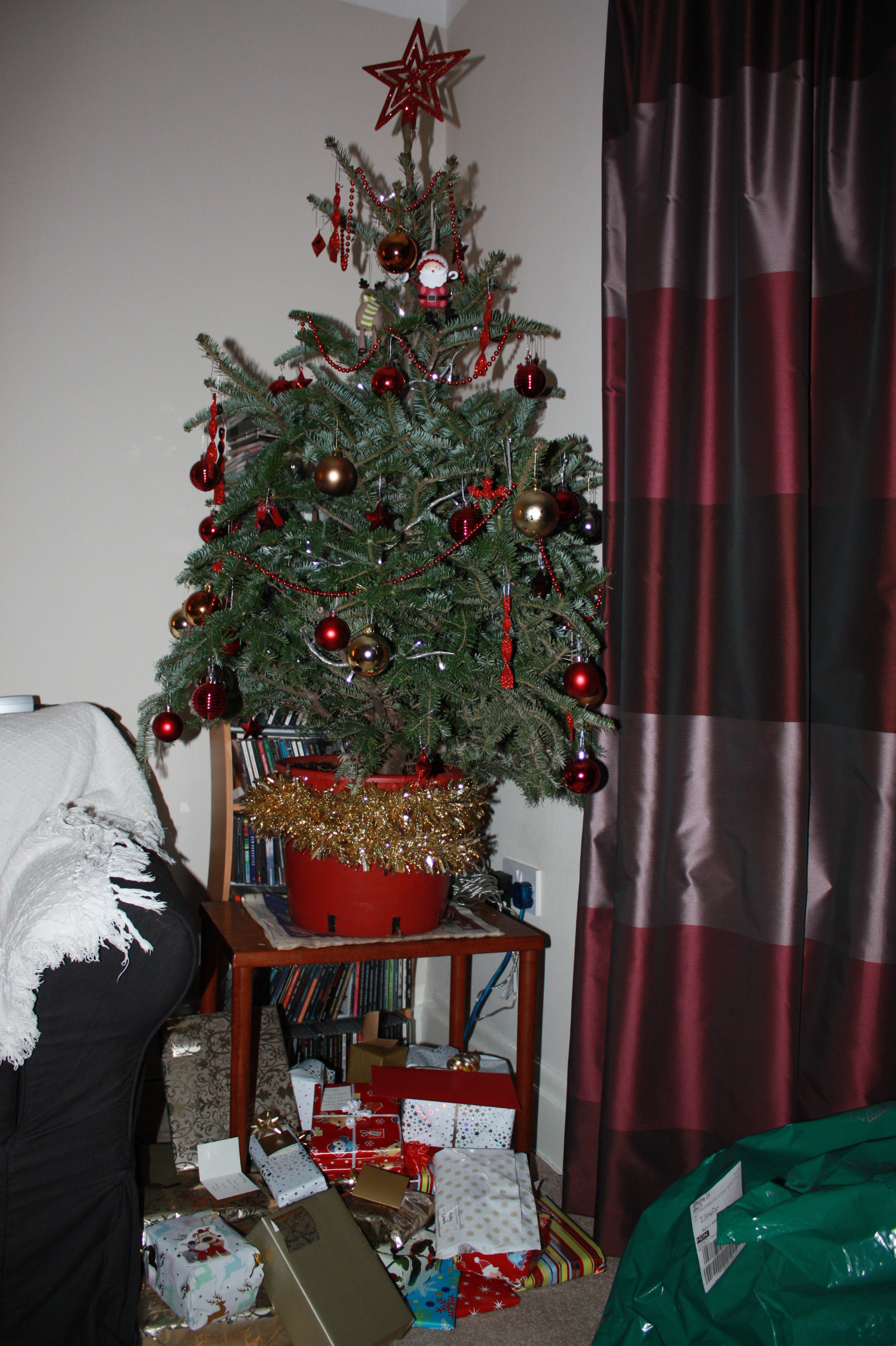
This was the first Christmas that the Munchkin has really understood anything about the holiday or been able to get excited about it. It was also his first healthy one! His first two were plagued by sickness bugs and fluey-colds for all three of us. Finally we have some nice photos of all of us looking healthy and well on Christmas morning. Yay!

In the build up to it he got excited about the decorations, especially the tree and he loved helping open cards as and when they arrived, the first few he memorised which was from who but eventually there were too many for him to keep track of. We noticed that he kept saying, with longing “Wish I had [insert name of train here]” a lot and hubby and I would cast furtive glances at each other, knowing we hadn’t bought him what he was pining after.

The solstice passed quietly, although that’s the meaningful day for hubby and I we prefer to celebrate the season with our families a few days later. So Christmas morning arrived and started well. The Munchkin was up relatively late for him, so we didn’t have the ridiculously early start we had prepared ourselves for. We’d put out the presents under the tree on Christmas Eve and didn’t really trust the Munchkin to play happily on his own in the living room like he usually does with all of those parcels tempting him, so knew we would have to get up at the same time as him.

Hubby distracted the Munchkin while I nipped to the living room and turned the tree lights on and when they came in we were treated to the biggest “wow!” you’ve ever heard. It was lovely. But we didn’t dive right in, we got breakfast and got dressed, took our time, determined not to start out on the road of presents being the all-consuming primary feature of the morning. The Munchkin was fine with this and went along with it amicably. Phew.

When we started opening presents it was all very sweet and peaceful, each gift was opened slowly and thoughtfully and the moment of revealing it was treasured. A few books came first and the Munchkin had a flick through each one, enjoying them and asking what they were about, appreciating who they had come from. It all seemed to be going perfectly.

But the pace began to pick up a bit and when the first of the train-based presents came out we noticed a change. The Munchkin no longer cared who the gift was from, he wanted to play with it right away, but only for a few seconds before clawing desperately at the next gift. Once all the presents were opened we took some time to play with the new toys and at lunch time my parents and grandfather arrived, to much excitement from the Munchkin. They brought with them more presents and so a second opening-session began, this one nothing like the relatively positive first one.

The Munchkin had no patience for opening the gifts, he wanted the paper off NOW and carelessly discarded it, each new train, for he received several, was met with a squeal of delight but very quickly it was cast aside in a feverish and desperate need for the next one. When all of the presents were opened he almost seemed disappointed and we were soon met with requests for more and choruses of “Me want a talking Gordon/Edward/Percy” etc.

My delightful, thankful, gracious little boy had been replaced with a greedy and impatient monster and I had to take myself off to my room for a little cry over it. What did we do wrong? How did this happen?

As the days have gone on his pleasure in his new toys has been very positive and the pining for the things he did not get has been steadily diminishing, but it isn’t entirely gone. There was, in fact, one talking train that we ordered that hasn’t yet arrived and hubby and I have decided not to give it to him right away when it does eventually turn up. We don’t want him to think that we got it for him because he was demanding it. We don’t want to encourage the idea that he will get whatever he asks for, whenever he asks for it. So we will save it and give it to him when the new baby is born instead.

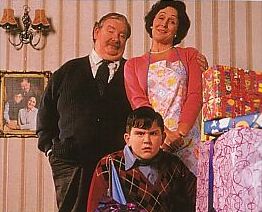
Hubby and I have done a great deal of talking over the last week, to see how we can nip this behaviour in the bud and try to prevent it developing into a Dudley Dursley situation (“36?! But last year I had 37 presents!”). This is what we’ve come up with:

  • Just one present from each family member. No more huge stacks, not even of small, thoughtful gifts. I’m confident that with some thoughtful explanation we can get our parents on board with this and more distant family and friends already only give one gift, which is as it should be.
  • Time tokens for all, for example, promises to cook for one another, or go for a walk together and so on. These can be unlimited. Day trips will become more of a feature too, tokens for days out at theme parks, museums and so on.
  • No more wrapping paper! Yes really. We’re thinking of each family member having a bag with their name on it and all the presents go in there, unwrapped. There is still the mystery and some excitement at discovering what’s in the bag, but the emphasis comes away from those physical gifts when they are not wrapped up individually. It also results in massive financial and environmental savings!
  • More regular giving of new stuff throughout the year. This might sound odd, but we think that by spacing out new acquisitions it will diminish the excitement and emphasis of those things on celebrations. It won’t be such a novelty to get a new toy or a new book. We don’t hesitate to buy the Munchkin new clothes as and when he needs them throughout the year, so why not do likewise with meeting his developmental needs with toys and books too? It also spaces out the spending so that December is less of a financial black hole, though see previous steps for the knock-on effect of reducing the cost of Christmas too!
  • We were already decided on not making a big deal out of Father Christmas and certainly steering clear of the bribery element (“Santa only brings gifts to good boys and girls”) and feel even more strongly about it now, confident that we are right in our stance on that one.

As a side note, we’ve also seen the wisdom in the decision of some of our friends to not send Christmas cards and will be following their example as of next year. The whole point of the Christmas card is, in my mind, to touch base with people, send them warm wishes and so on. But how many cards do we actually write a personal message in? Isn’t it better to reach out and actually speak to those we care about most in order to wish them well and catch up? Pick up the phone if you feel you’ve not kept up with someone as well as you would like. Duck out of the awful politics of who to send a card to and who not to, avoid the environmental and financial waste of cards that few people really value. I always buy charity cards made from recycled paper and recycle them again when I take them down, but the recycling process still uses energy and not all people do likewise.

Now that the festive season is coming to an end and the new year has begun, it’s all about our forthcoming new arrival. We have already begun de-cluttering the house; sorting out piles of paperwork and bills for filing, we’ve gone through our CDs, DVDs and even books (for those reading who know hubby in particular, this may come as a huge shock!) and started listing things on eBay. There’s a big stack of old clothes ready for charity donation. Hubby has tidied our cluttered landing and guest bedroom and we’ve retrieved our birth pool from the loft and checked that it is fit for re-use. The baby clothes have come out of storage, been washed and put in the baby’s wardrobe.

New year, new start, new life. Bring on 2012.

Yuletide Greetings

It’s almost upon us, Yule, or the Winter Solstice. It falls upon the 22nd December this year and is my favourite time of year. For those in the southern hemisphere it is of course, the summer solstice, so I’m speaking about the seasonal festival here in the northern hemisphere.

The winter solstice is the shortest day of the year, there is a good, basic explanation of the science here. Yule is an ancient Scandinavian festival that centres on fertility for the coming spring. The ancient Romans celebrated the solstice and called their 7 day festival Saturnalia, after the god Saturn. Solstice customs across Europe were absorbed into Christianity as it spread across the continent and many of the practices can be recognised in modern Christmas celebrations.

Yule has been adapted by modern pagans, of various paths, and features as one of eight annual sabbats. To me, it is a family festival, a time to slow down and be together, to shelter from the winter and celebrate the shortest day and the return of the sun as the days will only get longer from here on (until June, anyway!). We tend to celebrate on Christmas day with our families, as that’s the whole point of the festival for us, but I always look forward to the solstice itself as a turning point in the year and try to find a few moments to appreciate the wonder of the turning of the earth, the change in seasons and the promise of longer days.

As the Munchkin gets older we will incorporate this, and the other seasonal festivals, into our home education activities, chiefly through craft projects. There are hundreds of ideas online for decorations to make with young children at this time of year and recipes to cook and bake together. This year he is still a bit young and really not interested in crafts yet, he hates getting paint or glue on his hands! I took him to a lovely little café last week where you can buy plain pieces of pottery and sit and paint them while you enjoy a drink and bit of cake. They glaze it and fire it in the kiln for you to collect later. The Munchkin was a bit resistant and I did most of the work, but by the end he was at least happy to sit on my lap and pick what colours I should use and what words I should write. I can’t say exactly what we made at this point, but I will take photos after we exchange presents 😉

However you celebrate this time of year, many very happy returns.

“When are you due?”

It’s pretty much the first question from everyone who finds out that you’re pregnant. I think on a rational level, the vast majority of people know that you can’t really predict when babies will be born, but I suspect the majority still believe that the Estimated Due Date (EDD) is scientific and accurate at least some of the time. The truth is though, it’s an arbitrary date determined by outdated pseudo science, a best guess, based on the probable misunderstandings of ancient theories.

The theory goes that pregnancy lasts for 40 weeks (9 months + 1 week) from the first day of a woman’s last menstrual period (LMP). Where did this idea come from? It’s called Naagele’s Rule, named after German obstetrician Franz Karl Naegele (1778–1851), who devised the formula. I don’t believe that Naegele plucked this idea out of thin air, it is likely that he read Aristotle’s theory that pregnancy lasts for about 10 lunar months, and Naegele assumed that a lunar month was 28 days.

Aristotle, however, was what I call a “well rounded wise man”. He was a philosopher, mathematician, scientist and sociologist. With his education in physics, it is extremely likely that he knew that a lunar month is not in fact 28 days, but nearly 29.5 days, making 10 lunar months 295 days, NOT 280, over 42 weeks, NOT 40. What a difference to pregnancy length that makes. What Aristotle actually wrote was:

pregnancy may be of 7 months’ duration or of 8 months or of 9 and still
more commonly of 10 (lunar) months, whilst some women go even into the
eleventh month. 

http://www.ncbi.nlm.nih.gov/pmc/articles/PMC1341914/pdf/bmjcred00258-0017.pdf

Naegele’s Rule also assumes that all women have exactly 28 day cycles and that they ovulate on cycle day 14. Obviously, this is not true. There is great variation in both cycle length and ovulation timing. There is a suggested alternative formula, Parikh’s Formula, which is a date calculated by adding 9 months to a woman’s LMP, then adding the length of her average cycle, then subtracting 21 days. For example, a woman with 35 day cycles whose last period began on 1st January would do the following calculation:

1st January + 9 months = 1st October

1st October + 35 days = 4th November

4th November – 21 days = 14th October

This EDD is approximately one week later than EDD calculated by Naegele’s Rule.

A small study in 1990 by Mittendorf et al. found that the parity of the woman was a factor in the length of her pregnancy. First time mums had an average pregnancy of 41 weeks and 1 day (41+1), second and subsequent babies arrived at an average of 40+3. Some studies have also found racial variations in pregnancy length.

Normal human gestation is usually defined as 37-42 weeks, by the WHO, maternity professionals and academics, and yet the myth of the EDD persists. Midwives and obstetricians do nothing to correct this misconception, they often seem to fixate on the EDD, first calculated by LMP and then by ultrasound, the infamous “dating scan” that most pregnant women have at about 12 weeks in the UK. (My views on the reliability of ultrasound are explored in my previous post “Guess the Weight”). The dating scan has a 6 day margin for error, officially, and yet it is relied upon so strongly that a woman’s knowledge about her own body is usually dismissed in favour of what the machine says. For instance, were we using NHS maternity services for this pregnancy, the sonographer that did our early pregnancy scan (for reassurance) would have us believe that this baby was conceived 8 days prior to ovulation and 3 weeks after the last time we made an attempt to conceive, a passing familiarity with human conception will tell you that this is impossible. No, in fact, this baby was conceived when I actually ovulated and not by some freaky and convoluted miracle process of my dear husband’s swimmers breaking all records and my body releasing an egg more than a week before all the physical signs indicated the possibility.

Even so, knowing when you conceived doesn’t actually give you any particular insight into how long your pregnancy will turn out to be. Gestation is a natural process and as such, it can’t be timetabled. There is great variation and most of it is completely incomprehensible, there is no known explanation for the wide variety in gestation lengths, it’s just an organic part of life and one that I think we would all do well to accept.
People pin all of this importance on the EDD and their care providers make it worse by rushing to intervene as soon as pregnancy continues beyond 40 weeks, which it does in more than 50% of all pregnancies! In my own small way, I try to challenge this by reminding people of the “Estimated” in EDD and emphasising that normal pregnancy is 37-42 weeks. I have also refused to tell anyone the precise date that I will be 40 weeks pregnant. I know when that date is, as I know when we conceived, but it is not my EDD, to me there simply is no such thing as an EDD. Our midwife knows the 40 week date, but together we have no expectation that there is anything special about that one day. It’s a vaguely useful day to note down so that we have an idea of what 5-6 week period the baby might put in an appearance, that’s all. To all of our friends, family, neighbours and random acquaintances, we expect this baby to arrive some time in February, probably.

When Headlines Are WRONG

I think most people probably know that newspapers are not always the most reliable sources when it comes to conveying factual information. Certain papers tend to sensationalise things and some even tell outright lies to their readers in order to sell more papers. Because the real news is often nowhere near as interesting as the made-up stuff.

What kinds of headlines sell newspapers? Babies dying, sadly, is a big seller and it’s one we’ve seen in the wake of the release of the long-awaited Birthplace Report, which was published yesterday. The Daily Fail notoriously misreported the study’s findings, with a lead headline of

First-time mothers who opt for home birth face triple the risk of death or brain damage in child

  • Half of women who chose home births had to be transferred to hospitals due to complications

Both of these statements are complete lies. Not just minor misrepresentations or misinterpretations of the facts, but actual lies, told to scare the public and stir up an emotive debate.

You may be able to tell that I have absolutely no respect for this publication, or others like it.

So, what is the truth behind this sensational headline?

The Birthplace report really did find an increased risk of death (stillbirth and neonatal mortality), brain damage (infant encephalopathy), meconium aspiration syndrome and bone fractures in the arm and collar bone in babies of first time mothers who plan home births, deaths did NOT make up the majority of these outcomes. HOWEVER, it was less than twice the risk of babies born in other settings, not three times the risk. Also, the actual risk is still less than 1% and the results are looking at the short term only, it is entirely likely that most of these babies are perfectly well after treatment.

Mothers who have children already face absolutely no increased risk to their babies by birthing at home.

There were so few infant mortalities in the study that the researchers decided to compound the results of a range of adverse outcomes in order to produce a study with statistically significant results. I have mixed views on this. On the one hand, it muddies the waters by mixing up the worst case scenario for the baby with a host of lesser problems. On the other, it does demonstrate very clearly just how safe birth is in the UK today (with a less than 1% risk of anything significantly bad happening to a baby, regardless of where it is born or how many babies the mother has had before).

As for the “Fail”‘s other assertion, well actually, it was less than half of mums, about 40%, who transferred and most of them were not for “complications” but for the infamous “failure to progress” and epidural pain relief.

A more accurate, and just as attention-grabbing headline might have read

Low risk mothers who plan hospital births are three times more likely to have an unplanned caesarean section than in any other birth setting

The study found that women planning births at home and in birth centres (both freestanding and attached to an obstetric unit) were overwhelmingly better off than those planning to birth in obstetric units. Women in hospital had a mere 58% chance of having a normal birth, whereas those planning to remain at home had an 88% chance. This study didn’t even touch on long-term results, such as breastfeeding duration or mental health.

These are all low risk women. And their health matters. Yes, we all care very much about babies and no one loves a mother’s baby or wants the best for it as much as she does… but mothers matter too. A healthy baby might not stay that way with a damaged mother and a damaged mother may remain damaged for the rest of her life as a result of her birth experience.

The elephant in the room with these results is… why do women do worse in hospital than in any other setting? The study can’t tell us that, but there are a number of theories. The most compelling to me personally, is that obstetricians view birth as a problem that needs fixing and that they have a tendency to step in and interfere where no interference is actually necessary. In an obstetric-led unit, even though all low risk women will be cared for primarily by midwives, there are always obstetricians waiting in the wings for something to do. At the study launch event at the Royal Society of Medicine yesterday, Dr David Richmond, Vice President of the Royal College of Obstetricians & Gynaecologists (RCOG)  implied as much in his talk when he showed a slide of Mount Everest and quoted Sir Edmund Hillary, who famously replied to the question of why he climbed Everest with “Because it’s there”.

Those of us who have taken an interest in normal birth and taken the time to investigate how birth works, are aware that birth goes the smoothest away from time limits, bright lights, loud noises, routine interventions and alien environments, i.e. at home. So the results of this study are no surprise. Women do best at home.

I think it’s very important for women to have access to the right information, presented in the right way, to enable them to make choices for their births, so let’s just compare the statistics for a moment.

  • A first time mum has roughly 0.5% chance of anything bad happening to her baby in hospital or in a midwife led unit. She has a less than 1% chance of anything bad happening to her baby at home. At home her baby is nearly two times more likely to have an adverse outcome.
  • The same mum has a roughly 15% chance of an instrumental delivery (ventouse or forceps) in hospital and 4% chance at home. In hospital it is over three times more likely.
  • She has a 10% chance of a c-section in hospital, less than 3% chance at home. In hospital it is over three times more likely.
  • There is a 23.5% chance of having her labour augmented in hospital (with all of the associated risks to both her and the baby that come with that) and just 5.4% chance at home. In hospital it is over four times more likely.

I’ll leave it up to each reader to digest those figures and decide for themselves where their preference for birth place lies, but do remember that these are all like-for-like mums, they are all low risk, so what these numbers suggest is that it IS the place of birth that influences the numbers. The mere fact of being in hospital makes these interventions more likely, and avoidable by staying at home or birthing in a birth centre (which tend to come out roughly the same as home or somewhere in between the two). It’s not that more women in hospital need these interventions because they are high risk.

Next time you read a sensational headline in the press, take a moment to think about what they aren’t telling you or the fact that they could actually be telling a barefaced lie.

Sleep Training Our Munchkin

We finally decided that the time is right to sleep train the Munchkin. He is still largely parented all the way to sleep, with a good wind down routine followed by me or hubby sitting by his bed, holding his hand (at his insistence) until he falls asleep. Previous attempts to leave the room with him still awake have resulted in meltdowns, or at the very least a shout of “No!”

With a new baby on the way, we can’t possibly spend 2 hours every evening putting our nearly 3 year old to sleep, so he is going to have to learn to do some of it on his own. Up until lights off point, nothing has changed, but the method of sleep training we have embarked upon is that of Controlled Giggling (sadly not covered in the book, pictured left).

It’s very simple. The light goes off, his night light goes on. He gets cuddles and kisses from us both and we leave the room. When he giggles we ignore him for increasing increments of time, then go in, settle him back down and then leave again. It hasn’t yet got to the five minute mark as he comes running out into the hall grinning and laughing long before then, so one of us escorts him back to bed and does the above.

The first two nights of this, he only emerged from his room, red faced from laughing so hard, twice before going quiet and going to sleep. Last night, however, he regressed somewhat and it took a good 7 or 8 attempts to resettle him before he gave up and went to sleep. I hear that this is normal and that our approach should remain unchanged. If, however, he takes to deliberately laughing so hard he vomits, in order to manipulate us, we should start lining his bed with towels, so that we can clean up as quickly as possible without looking at him. He currently has a 2.5 tog child’s duvet, but we are considering upping this to 14 tog for the winter, as per the very excellent advice available from reputable sleep trainers online.

Now I just need to find an appropriate sleep training method for myself, as I’m currently up and writing this at 3.40am, having tossed and turned for an hour and a half due to terrible back ache. I wonder if the more aggressive sleep training method, Giggle it Out, would be effective in my case? I’ll have to talk to hubby about it as he would have to completely ignore me no matter how hard I laugh or for how long. It’s a lot of pressure on him.

Night all.

Montessori Nursery a Big Hit

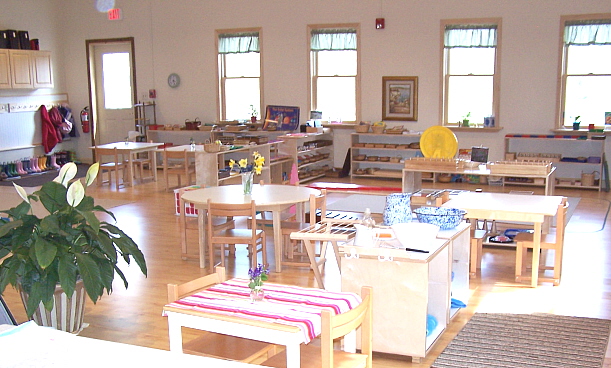
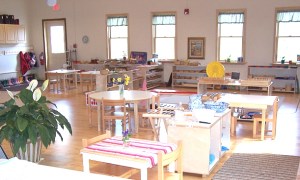
Typical Montessori Learning Space

Our plan is to home educate our children, for a variety of reasons, we feel it is the best option for our family. For some time now I have maintained that the Munchkin would not be going to nursery for this reason. Why prepare him for school when he isn’t going? But we have also always said that we would remain flexible and meet the actual needs of our children, rather than adhering steadfastly to some sort of super-plan.

Well, I’m getting bigger, slower and more tired. The Munchkin is getting bigger, heavier and faster. Oh man, is he hard work these days! An absolute joy, don’t get me wrong, but he is hungry for more interaction and more new people and places and I am struggling to keep up with him or get him out to enough groups to satisfy his thirst for activity.

There are lots of home education activities in our area, we have a thriving HE community, with several children three years and under, but “our area” is actually county-wide and not all of the activities are suitable for children as young as him. One of my main motivations for finally learning to drive this summer was to get him out to more groups, as it was proving impossible to do so relying solely on public transport. However, I’m still not getting to any HE groups and only sporadically managing generic under 5’s groups as my energy levels are somewhere in the sub-basement.

So, after some long discussions, hubby and I decided to check out our local Montessori nursery, with a view to the Munchkin having a couple of sessions a week there to give me some relief and him some much needed play time away from home. We have a couple of friends who send their little ones there and are very happy with it, we generally like the Montessori approach to education and are planning to utilise bits of it at home ourselves.

After exchanging a few emails with the principal, hubby and I took the Munchkin along this morning for a “quick half hour” visit before hubby had to be at work. That “quick half hour” turned into three hours of some of the most positive play I have ever seen the Munchkin engage in. Given that hubby had to be at work, we even left the Munchkin there alone for half an hour while I drove hubby to the office in the next small town and then came back again. Not once did he even ask for us while we were gone!

The Munchkin isn’t shy, he will very happily chat to complete strangers in a café , on a train, in the supermarket, etc. But usually when we go somewhere new that is clearly a designated child space; be it someone else’s home, or a group, he sticks close to me for a few minutes and prefers to play on his own for the most part. Even with other children that he knows well, it can take an hour or more to warm up to that child enough to play with them, as opposed to side by side but independently. In groups of more than two children I have never known him interact with others, he seems to prefer his own space and to do his own thing. For this reason, I have been convinced for some time that nursery would be the wrong setting for him and been content to stick to play dates with one or two mum friends and their children at a time.

Today was a whole different story. He was his normal, cautious self when we arrived. It took a bit of coaxing to get him into the main play room from the entrance way, but once he was shown where the train set lives he came completely out of his shell. Within five minutes of arriving he was not only playing happily without either of us, but he was engaging with the other children too. He did ask me to join in with him a few times over the course of the morning, and was keen to show me what he was doing, but I think had I not come back after taking hubby to work, he wouldn’t have missed me at all.

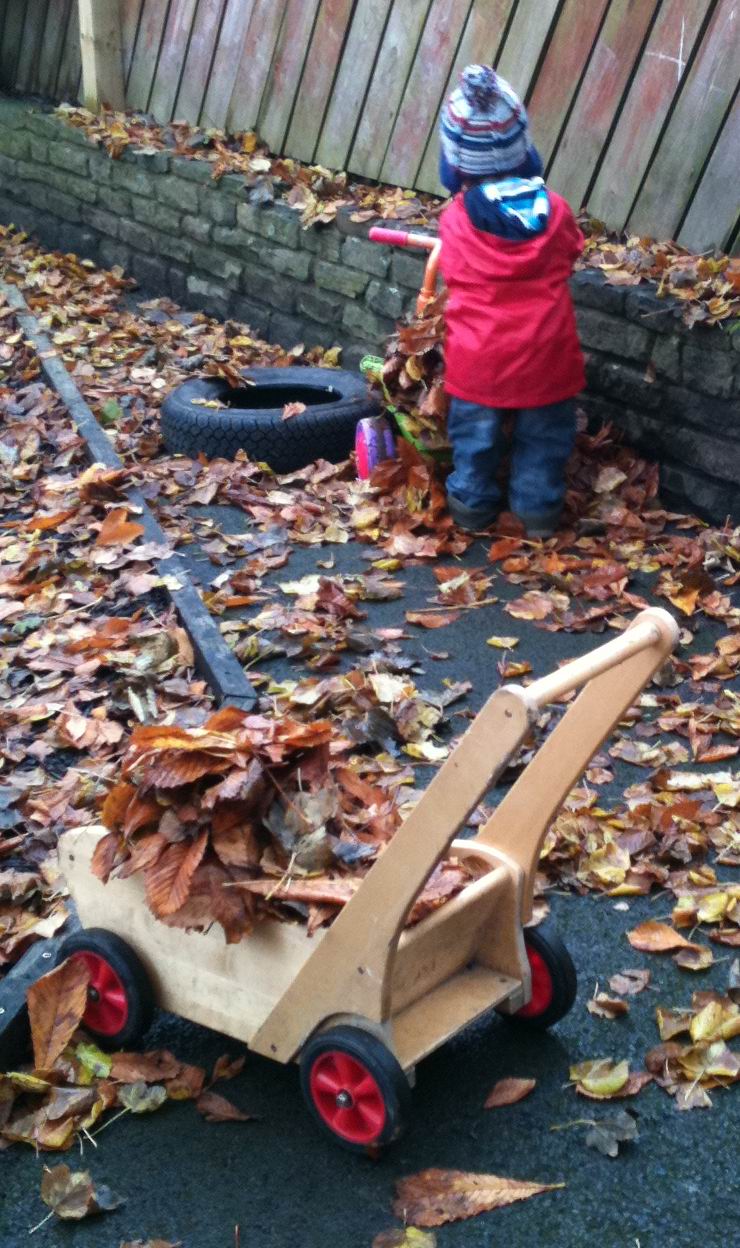
At about 10.30 the children decided to play outside. There is no structure to their day, they follow the children and apparently have at least one but usually two sessions of play outdoors every day, no matter the weather (love that part, hooray for puddles!). The Munchkin was in the middle of the group as they burst out of the door and he had a wonderful time sweeping the leaves and piling them into a little wooden trolley and then working with a little girl to bury a tricycle with them. We have had to abandon arts and crafts as he hates having anything he perceives as mess on his hands. Even meal times have become a challenge, with him asking to be cleaned every time food gets on his hands. But this messy play with the leaves was totally acceptable to him and he only asked for his hands to be cleaned once mid-play, there was even some reluctance when I cleaned them again as we were getting ready to leave.

I was itching to get off, feeling that I had had all of my questions answered and having other things planned for the day, but it took over an hour of gentle persuasion and bribery before we left. Even “Shall we see if nana is home and go to her house?”, which is normally enough to convince him to leave whatever and wherever we are, was met with the reply “No. Busy playing here.”

I was stunned, to say the least. Lunch at a café was passed up, home to his own trains returned “No, we can’t do that yet.” and all afternoon I was being asked if we were going back to “that place” again and his absolutely adorable “pleeeease”.

I managed to convince him to leave after using all of my usual tools, including the tactic of letting him do one more thing that he really wants to do and then doing what I want him to do. That was the winner in the end and we left with, surprisingly, no tears and a cheerful goodbye to everyone. We got my odd jobs done and had lunch in a café , as he was finishing his lunch he grinned and asked “We go to nana’s house now?”, clearly remembering my attempt at bribery from at least two hours previously. So one quick phone call to my mum and we were on the road to my parents’ place, via home to collect more clean nappies, as I hadn’t planned to be out all day!

He couldn’t wait to tell nana and “Ash” (his name for grandad) all about nursery and even when we went back to hubby’s office to collect him at the end of the day, the Munchkin was still asking to go back to play at “that place”.

I remarked to hubby about the level of development in the Munchkin from one short morning at this place; the confidence and independence, the willingness to get mucky and the eagerness to return are all fairly new to us.

It’s a good job hubby and I were as impressed with the place as the Munchkin is really, but I’m not sure what we’ll do if two half days a week aren’t deemed enough by him, as we really can’t afford more! Roll on third birthday and 15 hours of free childcare!

We certainly won’t be making any rash decisions at this stage about long term educational plans, but for now, this arrangement looks like it will be a winner for us all and maybe we can look at the idea of flexi-schooling later if this nursery gets its free school status approved for 2013. I’m still a firm believer in HE, and that is still my preference, but who am I to deny my little boy something that he gets so much out of?

Switching Off and Being a “Normal Mum”

Twice in just a few days I have been in situations where it is probably best to switch off my campaign head and shut up, be a “normal mum”, whatever that might mean. The first of these was the first of two Natal Hypnotherapy workshops that hubby and I are attending in preparation for this birth and I didn’t do so well. The second was my aquanatal class today. I did better.

I’ve always found it hard to know when to shut up and keep my opinions to myself and have probably pushed a fair few people away because of it in the course of my life. When my passions are raised they tend to spill out of me, but I’ve worked hard to get it under control and generally I think I do a better job now than ever before.

When it comes to birth, it’s a bigger challenge than most issues I’ve felt passionate about in my life. It’s such an intimate topic, birth is the single most significant physical act that a woman embarks upon and also the one fraught with the highest emotional investment too. I know that birth can be amazing and I know that all women deserve excellent maternity care. I know that there are fundamental, systemic problems with NHS maternity services that prevent the majority of women from having the births they should have. I hate seeing women being trampled on and abused by their care providers and it makes me angry and deeply saddened that I can even use the word “abused” there and know it to be no overstatement or falsehood.

Last Friday at the Natal Hypnotherapy workshop, I had to tell myself not to go to it expecting that I would know everything already and to accept any new knowledge or tools presented to me. At one point, having answered every question about hormones and birthing positions that we were asked, I actually apologised and made an effort to keep my mouth shut to give one of the others a chance to answer something. I felt a bit like Hermione Granger.

One of the other ladies on the course is also planning a VBAC and I couldn’t stop myself from making suggestions about which interventions she might wish to think more about. I don’t think I came on too strong there, but over lunch discussion turned to placentas (yes, over lunch) and I went and mentioned the fact that we’re planning a lotus birth. I think the others were mostly just intrigued, until I went a step too far and mentioned consuming the placenta as another option. I suspect I came away from lunch looking like a very weird hippy.

This afternoon was my aquanatal class, which I go to for the exercise and “me” time. After the class we sit in the café for a chat and the first time I went it was just me and the two midwives who run the class. We had a fantastic chat and I told them about what I do and which groups I’m involved in. They are lovely ladies, very keen on what they do, which is helping women keep fit and healthy in pregnancy and they have their gripes with the NHS, and so no longer work within it. However, I do suspect that they don’t see quite the same problems that I do.

Today there were others present, one lady due in a month or so and another who had a home birth a few months ago, another lady due early next year. I was very grateful for the home birthing mum’s presence, as she was able to say some of the things I would have loved to say, but in a much more palatable way than I can sometimes be guilty of. She was a normal, non-campaigning mum, a mum who only breastfed her eldest for a few months (compared to my 2.5 years) and who told us that her home birth “bloody hurt” and that she had a third degree tear and had to have a spinal afterwards while being stitched up. She was absolutely supportive of home birth and said she would do it again if she ever has another baby, but she definitely wasn’t ever going to come across as the dreaded hippy-type or militant birth campaigner. Like me.

For the most part I just nodded in agreement with her. When the nearly-due lady asked if it was possible to hire a midwife privately, as hers is so rubbish, I was able to espouse the virtues of independent midwifery and I also mentioned doulas. I think I managed to toe the line I find so difficult, that of switching off my campaigning head and just being a normal mum, talking to another normal mum and hopefully pointing her gently in a sensible direction that will help make a positive birth attainable. Maybe next week she’ll be telling us that she’s booked a home birth and hired a doula. Maybe even an IM. I hope so, for her sake.